Chapter 7
The Sharif and the Hijar
1328–1330 AH
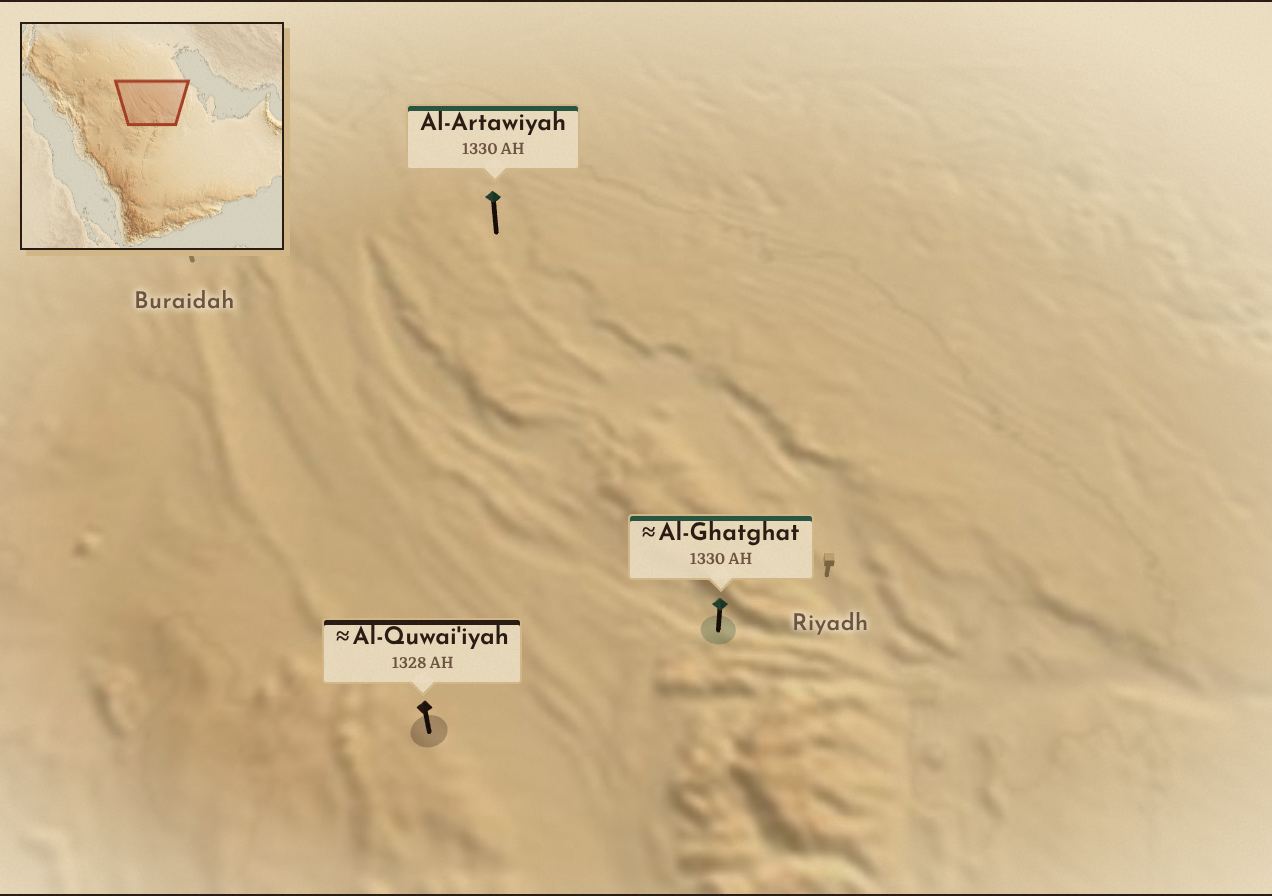
- 1328 AHThe Sharif attacks Al-Quwai'iyah
- 1330 AHAl-Artawiyah, the first hijra
- 1330 AHAl-Ghatghat
Sharif Hussein bin Ali had recently been appointed by the Ottoman state to rule the Hijaz. The Ottomans hoped to end Abdulaziz’s power, but their bet on Ibn Rashid had failed, and their small garrison in Al-Ahsa, surrounded by hostile powers, could do nothing. The Sharif had ambitions of his own: he wanted to be more than an Ottoman governor, and he would later lead the Arab Revolt.
At this time Abdulaziz held Najd, the Sharif the Hijaz, and Ibn Rashid Ha’il. There was an Ottoman garrison in Al-Ahsa, the Al Aidh family in Asir, and the Idrisis in the Sulaymani Mikhlaf (Jazan). The Ottomans cared about the Hijaz above the rest of the peninsula because it gave them religious authority, especially under Sultan Abdul-Hamid, when the idea of an Islamic caliphate was revived.
The Sharif supported Abdulaziz’s enemies, including Ibn Rashid, with whom he kept up a steady correspondence. His army was partly organised and partly tribal: like any Ottoman province, it had a garrison alongside local forces and tribes whose loyalty to the governor varied.
In 1328 AH the Sharif attacked Al-Quwai’iyah and captured Abdulaziz’s brother, Prince Sa’d ibn Abdulrahman, who was released after negotiations.
The Hijar
1330 AH marked a turning point. That year Abdulaziz began founding the Hijar (singular hijra), new settlements for the tribes, starting with Al-Artawiyah, the first, and Al-Ghatghat.
The Hijar were a civilisational project, not a military one. Their aim was to build a society with a shared outlook. A hijra was a grant to a particular tribe: its sheikh settled there, his people gathered around him, and scholars were sent to teach them.
Such large groups could not simply be absorbed into existing towns, which would have been overwhelmed. (A historical parallel is the founding of Samarra in Iraq, built to relieve Baghdad of its Turkish troops.) So new settlements were built, with wells, kuttab schools and houses, the basics of settled life.
Settling the tribes in fixed places brought stability and security. If a caravan was attacked, for example, the source of the trouble could be traced. The name hijra, “migration”, reflected a tribe’s move from its scattered territories to one place.