Chapter 5
Recovering Riyadh
1319–1320 AH
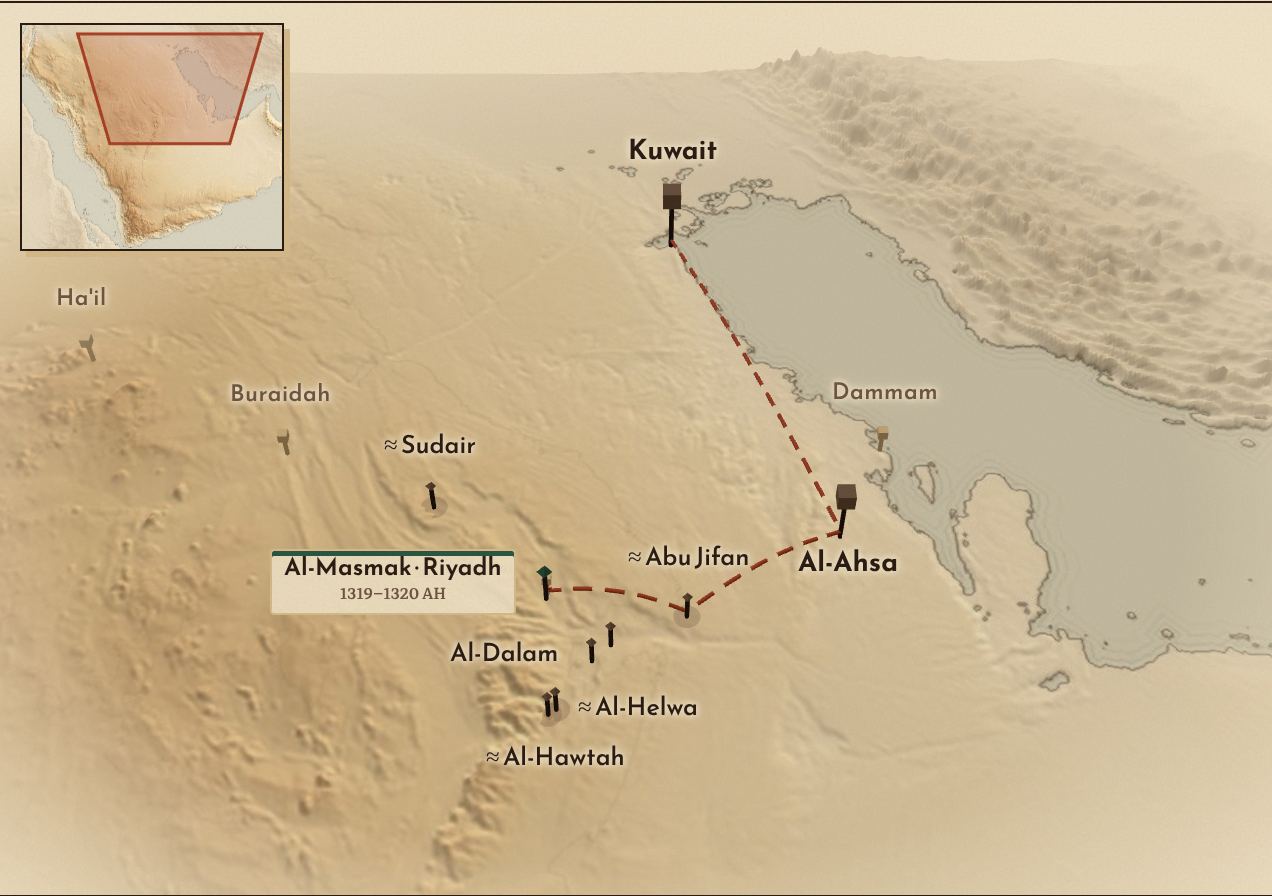
- 1319 AHRiyadh recovered at Al-Masmak
- 1320 AHIbn Rashid besieges Riyadh
Back in Kuwait, Abdulaziz pressed his father until Imam Abdulrahman agreed to let him go. The Imam urged him to be patient and build up military strength first, but Abdulaziz was determined and confident that he would recover Riyadh.
Forty men
He left Kuwait with forty men and headed for the east of the peninsula, around Al-Ahsa and the Empty Quarter. Twenty or twenty-three more joined him (the sources differ), making sixty to sixty-three men, armed with simple rifles.
In 1319 AH he won over tribes in the region to join an attack on Riyadh. By one report he gathered 1,500 camel riders and 600 horsemen, although these numbers are doubtful. Ibn Rashid readied his garrisons in the towns of Najd, in Al-Qassim, Sudair and Shaqra. He also pressed the ruler of Basra, Qassim ibn Thani and the Ottoman deputy in Al-Ahsa. They threatened the tribes with reprisals and with cutting off their supplies. The tribes withdrew, and Abdulaziz was left with about sixty men. This was in Rajab 1319 AH.
Imam Abdulrahman sent two messengers asking his son to come home to Kuwait. Abdulaziz addressed his men in front of them. Whoever wished to return to his family, he said, could go to the left with the Imam’s messengers; whoever would stay with him should go to the right. Every man went to the right. “Send my greeting to the Imam,” he told the messengers, “and tell him we will meet in Riyadh.”
The hidden wait
With the tribes gone, Ibn Rashid believed the threat was over. His garrisons around Riyadh pulled back and he returned to Ha’il. Abdulaziz, meanwhile, camped in hiding west of Al-Ahsa for a month and twenty days. He did this deliberately, so that his enemies would think his plan had ended and stand their garrisons down.
When Sha’ban and twenty days of Ramadan had passed, he moved toward Riyadh. He reached Abu Jifan around the eve of Eid and told his companions to put on their best clothes: it would be one of two things, he said, to die, or to celebrate Eid in Riyadh.
The night in Riyadh
On 4 Shawwal he reached a ridge called Al-Shuqaib, east of today’s Riyadh railway, near Omar ibn Al-Khattab Road and the park known as the Manakh. There he left twenty-three of his sixty-three men with the camels and equipment and went on with forty. At Al-Duhairah, just outside the town, he left thirty-three men under his brother Mohammad ibn Abdulrahman. “If you do not hear from us by morning, leave,” he told him. “We will have been martyred.”
He went on into Riyadh with seven men. He knew the town and its houses. At night he knocked on the door of Joyser, a trader in sheep and cattle, and pretended to be a man sent by Ajlan, Ibn Rashid’s commander in Riyadh, to fetch two cows. Joyser knew it was not the voice of the man he claimed to be, Ibn Mutref; he thought it was the voice of Abdulaziz, and opened the door. Abdulaziz held on to him so that no word would get out.
Joyser’s house was part of a cluster of houses joined to Ajlan’s. This let Abdulaziz reach Ajlan quietly without using the street. His plan was to take the commander: remove the head, and the rest would follow. In Ajlan’s house he tied up the servants and went to Ajlan’s room with his rifle, but found only Ajlan’s wife and her sister. Ajlan, she said, spent every night in Al-Masmak with his garrison and came home in the morning, “three spears after sunrise”. Abdulaziz locked them in.
He sent for the thirty-three. They waited in the house, watching Al-Masmak’s gate from an upstairs room, drinking coffee and going over their plan.
The gate of Al-Masmak
In the morning the gate of Al-Masmak opened. The servants and soldiers left for their homes, and Ajlan came out, with the horses let out to move around the fort. In one account, Ajlan sensed something was wrong. He was surprised to find Abdulaziz in front of him, rifle in hand.
Ajlan drew his sword, and Abdulaziz shot him in the hand. Ajlan’s men ran back into the fort through the khokha, a small door in the main gate wide enough for only one man, which is still in Al-Masmak’s gate today. Ajlan got halfway through it, and Abdulaziz caught hold of him and pulled. Abdulaziz later told how Ajlan kicked his legs so hard he nearly fainted. A spear was thrown at Ajlan; its broken head is still lodged in the door of Al-Masmak.
It was all over in seconds, in less than a minute. Abdulaziz tried to follow Ajlan through the khokha, but his men held him back. Abdullah ibn Jiluwi went in and shot Ajlan.
His men opened the gates and exchanged fire with the garrison of 100 to 150 men, not all of them soldiers. Twenty took refuge on the west side of Al-Masmak and were besieged until they were allowed to leave in safety.
Riyadh was then a small cluster of houses. Hearing gunfire, people stayed indoors, not knowing what was happening, until the call rang out: “Allah rules first, then Abdulaziz ibn Abdulrahman.” The people of Riyadh celebrated and pledged allegiance to him at Al-Masmak.
Holding Riyadh
Abdulaziz sent Prince Naser ibn Saud to Kuwait to bring Imam Abdulrahman. He called in the men waiting at Al-Shuqaib. As word spread through the nearby villages, Al-Washm and Sudair that Abdulaziz ibn Abdulrahman Al Saud had come, men joined him in their hundreds. Within days his force numbered about a thousand.
Imam Abdulrahman arrived in 1320 AH, and Abdulaziz camped outside Riyadh to receive him with honour. He told his father, “I am your servant, and you are the Imam again.” The Imam refused, holding that his son was the rightful ruler. Letters went back and forth, and scholars were drawn in to persuade them both. In the end Abdulaziz accepted, on condition that his father’s word would always come first. That arrangement lasted until Imam Abdulrahman died in 1346 AH.
Abdulaziz knew Ibn Rashid would come to besiege Riyadh. Within five weeks he used all his men to rebuild the town’s walls. He then left 1,000 men in Riyadh with his father and withdrew south with about 2,000 men from the south of Riyadh who had pledged allegiance to him. Ibn Rashid’s hold was weaker there, among Bani Tamim in Al-Hawtah and Al-Helwa, and in Al-Hariq, Al-Kharj and Al-Dalam.
The people of the south had a reputation for fierceness. In 1253 AH, under Imam Faisal, Ismail Agha’s attack on Al-Hawtah and Al-Helwa cost his army 2,400 dead, against 70 for the defenders. The bones were burned in a cave in Al-Helwa still called Ghar Al-Rum.
Abdulaziz spread his men across Al-Dalam, Al-Silmiyah, Al-Kharj and Olayya. He also spread a rumour that he and his father had quarrelled. Ibn Rashid could not decide whether to attack Riyadh or pursue Abdulaziz.
Ibn Rashid besieged Riyadh’s new walls for a few days, then went south after Abdulaziz. Instead of an army he found farmers among the palm groves. The people of Al-Kharj and Al-Dalam rejected the gifts he offered to win them over. For a month and a half Abdulaziz struck his army in swift raids, causing heavy losses. Then an epidemic broke out, adding to the confusion, and there was a retreat.
Ibn Rashid then pretended to march on Kuwait, and Abdulaziz set out to support Ibn Sabah. But Ibn Rashid turned back and besieged Riyadh. Abdulaziz learned of it early and trapped him between his own force and the defenders. Ibn Rashid retreated through Al-Swaidi, cutting down palm trees to pressure the town, until the people of Riyadh attacked and drove him away.